



Introduction
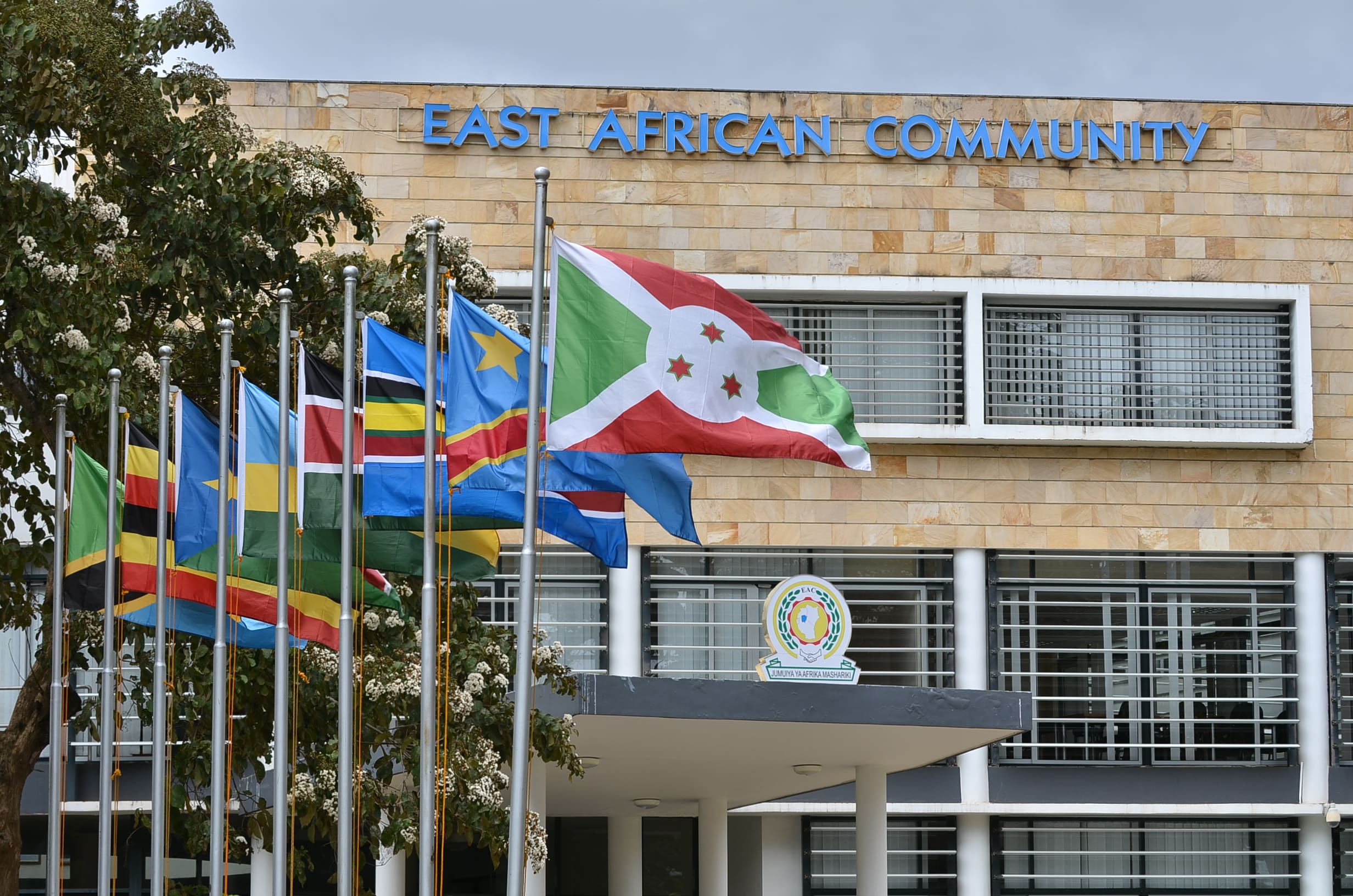
Pursuant to Article 23 (1) of the EAC Treaty 1999, the East African Court of Justice (EACJ) is the primary judicial organ of the East African Community (EAC or the Community). Article 9(1)(e) of the Treaty requires Partner States to apply and interpret the EAC Treaty. As the main judicial organ of the Community, the Court champions the realisation of economic integration. It does so through its jurisprudence, which helps develop policies and programs that widen and deepen co-operation among the eight Partner States (Kenya, Uganda, Tanzania, Rwanda, Burundi, South Sudan, the Democratic Republic of Congo, and the Federal Republic of Somalia), for their mutual benefit in the political, economic, social, cultural, research, technology, defence, security, legal, and judicial affairs as envisaged under Article 5 (1) of the EAC Treaty.
Although the Court is designed for trade and economic integration, it plays a key role in upholding human rights and, by extension, business and human rights (BHR) standards safeguarded under Articles 6(d) and 7(2) of the EAC Treaty 1999. These provisions expressly denote that Partner States are committed to the African Charter on Human and Peoples’ Rights 1981 and internationally accepted human rights standards such as the UNGPs. Nonetheless, since the establishment of the East African Court of Justice (EACJ), the Court still lacks jurisdiction in human rights and, by extension, business and human rights (BHR).
Article 27 (2) of the Treaty for the Establishment of the East African Community, 1999 (EAC Treaty), provides that human rights jurisdiction is contingent on the Council of Ministers concluding the requisite Protocol at a “suitable date.” However, “suitable” remains undefined. This leaves the expansion of the Court’s jurisdiction postponed. Consequently, as the push to hold corporations accountable for human rights violations rises, the EACJ could act as a regional judicial mechanism for BHR claims. In this context, the Court, though lacking explicit BHR jurisdiction, has potential, through EAC Treaty-founded principles, to address BHR‑related claims. As it stands, the Court’s jurisprudence shows its potential as a regional judicial grievance mechanism. This piece examines the EACJ’s historical journey toward express human rights and, by extension, business and human rights jurisdiction; its implied jurisdiction; the procedural and jurisdictional barriers to BHR claims; and concludes by exploring ways to make the Court a regional judicial remedy mechanism.
A Jurisdiction-less EACJ in Business and Human Rights (BHR) disputes
It is not contested that the EACJ lacks express jurisdiction over human rights and, by extension, BHR jurisdiction. Under Article 27(2) of the EAC Treaty, the Council of the Community is to conclude a Protocol in this regard at a “suitable later date” to grant the court express jurisdiction, but none has been concluded. As such, the Court implicitly possesses jurisdiction by virtue of the operational and fundamental principles under Articles 6(d) and 7(2) of the EAC Treaty. Hence, the Court utilises these principles to adjudicate disputes that affect human rights and, by extension, BHR claims and alleged violations despite the lack of express jurisdiction.
As John Eudes Ruhangisa notes in ‘The East African Court of Justice: Ten Years of Operation (Achievements and Challenges)’, efforts to expand the Court’s jurisdiction began in 2004, when the Sectoral Committee for Legal and Judicial Affairs proposed granting the Court jurisdiction over human rights. The Council of Ministers then recommended the proposal, and in July 2005, the Sectoral Council adopted the zero-draft Protocol on human rights as acknowledged by Elau in his paper ‘Human Rights in the East African Community.’ The Protocol was subjected to public consultations within the Partner States but according to Elau, this Protocol failed following a political reaction to the EACJ decision in Prof. Peter Anyang’ Nyong’o and Others v Attorney General of Kenya and Others. In that case, the EACJ restrained the recognition of 9 elected members from Kenya to the East African Legislative Assembly (EALA) because the election process was flawed and contravened the EAC Treaty. This decision affirmed the Court’s role in overseeing the Partner States’ commitment to the Treaty provisions. In response, some Partner States felt the Court had supranational authority, which resulted in amendments to the Treaty in 2006 and 2007, as expressly stated in the East African Law Society & 4 Others v The Attorney General of the Republic of Kenya & 3 Others. The amendments, as highlighted in the East African Law Society & 4 Others v The Attorney General of the Republic of Kenya & 3 Others, restructured the court into a First Instance and an Appellate Division, expanded the grounds for removing judges, limited the Court’s jurisdiction over Partner State organs, and introduced a two-month limit on individuals filing references, among other changes.
Subsequently, in 2010, the EACJ, in Hon. Sitenda Sebalu v The Secretary General of the East African Community & 3 Others, expressed the need to extend the Court’s jurisdiction to human rights. By 2012, national interests accelerated the expansion of the Court’s jurisdiction to cover human rights, including crimes against humanity, as key figures from some Partner States faced trial at the International Criminal Court (ICC), according to Human Rights Watch. This prompted the EAC Summit to urge the Council to expedite the extension of its human rights jurisdiction at its 10th Extraordinary Summit of the Heads of State in 2012. Later, in 2015, during the 15th Ordinary Summit of the EAC Heads of State, the EACJ’s jurisdiction was extended to cover trade, investment, and matters associated with the monetary union. Notably, the extension did not cover human rights, but the Summit, at paragraph 15 of the Communiqué, directed the Council of Ministers to collaborate with the African Union (AU) on the court’s jurisdiction in this area. So far, the African Union, through the African Court on Human and Peoples’ Rights, has collaborated with the EACJ and engaged in judicial dialogue on human rights experiences and practices. Although this contribution applauds the steps taken, leaving the jurisdictional gap as a matter of institutional collaboration does not resolve the concerns surrounding the absence of express jurisdiction to hear human rights violations and, by extension, BHR claims.
The EACJ’s implied jurisdiction over BHR-related matters
Based on the EACJ Law report from 2005 to 2017, the EACJ creatively exercises its implied jurisdiction by invoking the Community’s principles to offer remedies to victims. This role shapes commitment to business and human rights. The Court invokes Articles 6(d) and 7(2) of the EAC Treaty to address business and human rights claims, especially where Partner States are alleged to have failed to regulate business activities. For instance, in the Attorney General of the United Republic of Tanzania v African Network for Animal Welfare, Tanzania, a Partner State of the EAC, planned to build a Bitumen road to upgrade the Serengeti road and stimulate socio-economic activities within Serengeti National Park, but this was challenged. The EACJ issued a permanent injunction restraining construction due to the likely harm to the environment and ecosystem in the Serengeti National Park. In doing so, the Court delivered a non-state-based judicial remedy to prevent rights violations arising from the state-backed infrastructural business project. Similar dynamics are seen in the Court’s recent and ongoing cases. In the pending case of Environment Shield Limited & Another v The Attorney General of the Republic of Uganda, the Applicants argue that the approval of a sugarcane business project covering 9.24 square miles in Bugoma Forest Reserve in Uganda will have adverse effects on the environment and human rights, contrary to Articles 6(c) and (d) and 7(2) of the EAC Treaty.
The foregoing cases demonstrate that the EACJ already functions as a de facto forum for remedies in BHR‑related claims, despite the absence of an explicit mandate for BHR. Therefore, waiting indefinitely for the Council of Ministers to identify a “suitable subsequent date” and adopt a human rights Protocol that may or may not extend to BHR is not guaranteed. If interpreted broadly, the EAC Treaty principles address BHR claims. Yet, questions about procedural and jurisdictional barriers to BHR cases at the EAC level remain.
Procedural and Jurisdictional Constraints to BHR Claims.
This contribution concurs with Kamanga and Possi’s critique in their chapter on ‘General Principles Governing EAC Integration,’ where they criticise the deferral of the EAC Human Rights Protocol to an unspecified date. The two authors argue that such deferral perpetuates uncertainty about the Court. This uncertainty places the Court at a crossroads, given the centrality of BHR-related claims in its evolving jurisprudence.
As noted above, the EACJ’s role in addressing BHR claims is constrained by procedural and jurisdictional limitations. Notably, the court lacks express jurisdiction over private corporations and non-state actors who are major actors in BHR. Instead, Articles 28 to 30 of the EAC Treaty mainly frame references against Partner States. Thus, BHR claims in this context are inevitably tied to state action and the state duty to protect human rights, rather than to corporations. This jurisdictional constraint is evident in British American Tobacco v Attorney General of Uganda, where although the cigarettes produced in Kenya were more harmful to humans than those produced in Uganda, the Court focused on state compliance with Treaty norms rather than on corporate accountability. Similarly, a procedural barrier that poses an additional challenge is illustrated in Environmental Shield Limited and Another v The Attorney General of the Republic of Uganda and Another; and Centre for Food and Adequate Living Rights (CEFROHT) and Others v the Attorney General of the Republic of Uganda & Others, where an intergovernmental partnership agreement between Uganda, Tanzania, Total Energies, and China National Offshore Oil Corporation for the construction of the East African Crude Oil Pipeline (EACOP) along the Indian Ocean was disputed. Applicants argued that the construction posed risks to communities living in the affected areas and to the environment. Despite these adverse effects, the court dismissed the case on technical grounds, finding it time-barred because it was not brought within the 2 months stipulated under the Treaty. In November 2025, the EACJ dismissed the appeal, upholding the First Instance Division’s decision, a setback for the communities, as noted by the Business and Human Rights Centre in ‘East African court dismisses controversial oil pipeline case in setback to communities’. The dismissal shows how procedural constraints can affect substantive justice, since the case was never heard on the merits.
In addition, as Gathii notes in ‘Variation in the use of subregional integration Courts between Business and Human Rights Actors: The case of the East African Court of Justice,’ non-state actors also prefer diplomatic means to settle disputes within Partner States rather than litigating at the Court. This choice allows them to continue profiting, but it also limits exploration of the Court as a regional judicial system for addressing BHR claims.
Therefore, although the Court is bold and creative in using EAC Treaty principles to address disputes arising from business and human rights activities, its inability to directly address corporate accountability and strict procedural barriers, such as the 2-month timeline as per the provisions of Article 30 (2) of the EAC Treaty, limit access to effective remedies for aggrieved individuals or communities.
What next for BHR in the EACJ
Over time, the EACJ jurisprudence still relies on the Community’s principles to provide remedies in the absence of express jurisdiction. After twenty-two years of floating human rights jurisdiction based on the Community’s principles, relying on implied jurisdiction is an unstable basis for the long-term evolution of BHR decisions within the Community. The “suitable subsequent date” under Article 27(2) of the EAC Treaty 1999 can no longer remain an indefinite promise. The time is ripe for Partner States to mandate the Council to adopt a Protocol that grants the EACJ express jurisdiction over human rights and, by extension, BHR. In expanding the Court’s jurisdiction, caution is warranted because an express grant does not automatically resolve the accountability and procedural gaps highlighted in this piece. Consequently, any future Protocol should explicitly state the scope of the Court’s jurisdiction over corporate actors, especially the transnational corporations (TNCs) whose activities increasingly affect communities within the Partner States. In addition
This contribution further posits that given that Articles 28 to 31 allow individuals and corporate entities residing, working, or incorporated within the EAC to file a case against a Partner State or an EAC institution, the Community should adopt a Protocol that allows claims to be brought directly against companies.
To address procedural barriers and promote substantive justice, Article 30(2) of the EAC Treaty 1999 could be amended to include a provision that accommodates the continued or ongoing nature of BHR claims. Sometimes, businesses’ impact is continuous and can be felt over a long period. Hence, when the existing rule grants a two-month deadline from the complained act or from the date it comes to the complainant’s knowledge, it falls short of addressing ongoing violations. Amending the law to include such a provision protects human rights victims from being denied justice on the grounds of the statute of limitations, given that it takes time for rightsholders to identify, substantiate, or access evidence of the harm.
Separately, the existing alternative dispute mechanisms for resolving trade disputes for businesses, such as the East African Community Customs Union (Dispute Settlement Mechanism), Annex XI, could be revised to integrate business and human rights considerations as a complementary means of resolving conflicts, in support of the EACJ mandate
Lastly, holding corporations accountable is vital to accelerate economic integration, which is expected to pivot to political integration as espoused under Article 5 (2) of the EAC Treaty 1999. Currently, Partner States within the EAC have planned, developed, modified, adopted, and are implementing the UN Guiding Principles on Business and Human Rights (UNGPs) through their respective National Action Plans (NAPs). These efforts evidence the Partner States’ efforts to ensure access to effective remedies. At the EAC level, the EACJ should complement Partner States’ efforts without overlapping or duplicating. It can achieve this through its jurisprudence. As it stands, the Court, even without BHR jurisdiction, can still deliver justice and clarify the roles of Partner States and corporate actors in protecting human rights against BHR violations. Such jurisprudence could help establish a regional threshold for BHR standards within the Community. This approach could foster economic integration while ensuring accountability for BHR breaches.

Leave a Reply