







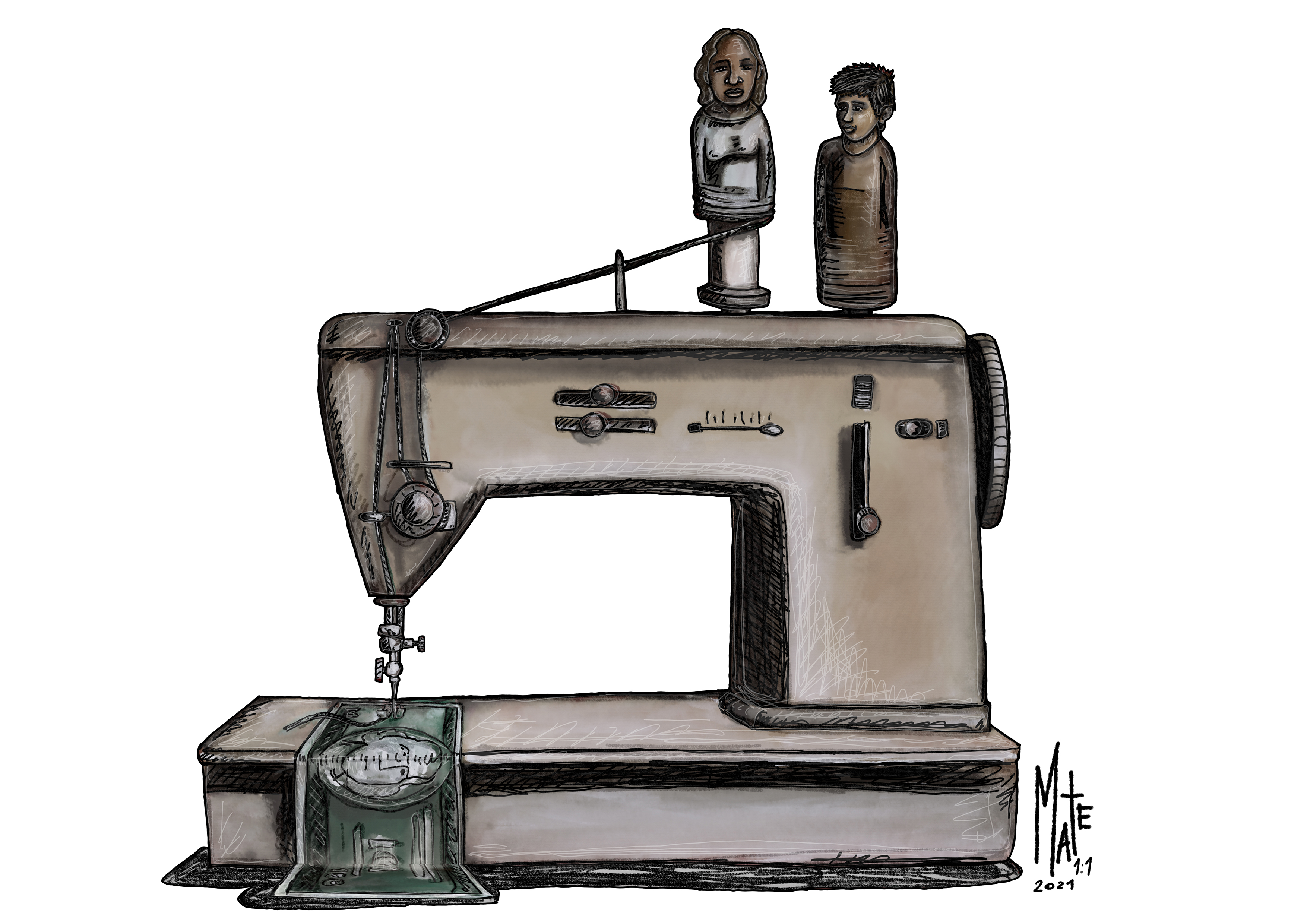
Excessive overtime is among the most commonly reported conditions in garment factories worldwide. Calling it ‘voluntary’ without questioning why it persists trivialises a form of forced labour that is widely documented and tolerated by the industry and the very initiatives pledged to end it.
As the spotlight turns to forced labour in light of recent regulations such as the European Union’s Forced Labour Regulation (FLR) and the revived United States Tariff Act of 1930 (Section 307), we want to highlight an evident indicator of forced labour in the garment industry: the failure to pay living wages.
In 2024, the ILO Meeting of Experts on Wage Policies defined living wage to be the amount “necessary to afford a decent standard of living for workers and their families, taking into account the country circumstances and calculated for the work performed during the normal hours of work”. Yet prevailing minimum wages for a normal 8-hour workday in key garment manufacturing countries fall significantly below the actual cost of living.
Refusing overtime (additional work hours beyond the normal 8 hours) carries the penalties of hunger, debt, losing employment and ultimately losing the purpose of paid work in the first place – to live a dignified life. This living wage gap, which is the difference between minimum wage and a living wage, thus compels workers into regular overtime. Yet current approaches to forced labour remain narrowly framed around managing ‘business risks’ rather than ‘risks to workers’ dignified livelihoods’.
Manufacturing the Myth of ‘Voluntary’ Overtime
According to the ILO Forced Labour Convention, 1930 (No. 29), forced labour is all work exacted under the threat of penalty and in the absence of voluntary consent. Besides punishments, that penalty can also be the loss of rights or privileges. The ILO lists excessive overtime as a forced labour indicator when “…workers face penalties for refusing overtime, such as dismissal, blacklisting or exclusion from future overtime opportunities.” In reality, ‘penalties for refusing overtime’ extend well beyond the factory floor, such as in the inability to pay for rent, food and medical care or losing one’s job for not being available to meet just-in-time production demands endemic to this global industry.
A common objection is that economic necessity alone does not make work forced. In this view, workers who stay in a job because they lack alternatives are not forced labourers. But this is not simply a matter of poverty – it is a manufactured constraint. Employers set the production targets and piece rates that make earnings within standard hours insufficient to live on. Meanwhile, the industry–state nexus in production countries keeps statutory minimum wages low, citing the need to compete in a cut-throat global market.
Existing national regulations also offer little protection. In addition to questionable state enforcement, legal overtime limits are often suspended, especially during peak production seasons, through clauses allowing for ‘special permission’ (see also Bangladesh Labour Act, 2006, Section 102; India’s Factories Act, 1948, Section 65).
Since the purchasing practices behind globally sourced garments do not account for the real cost of production, minimum wage negotiations continue to be an uphill battle. A comparison of multiple living wage benchmarks compiled by The Industry We Want shows gaps of over 50% between minimum and living wages in countries such as Pakistan, Indonesia, Cambodia, Bangladesh, China, Vietnam and India, and many more beyond Asia.
Lived Realities: How Poverty Wages Remove the Right to Refuse
The daily lives of garment workers, which we as labour researchers, practitioners and activists regularly encounter, illustrate the human cost of this predicament.
An average garment worker has to meet production targets ranging from 120–250 pieces per hour, for 10–12 hours a day including overtime.
Take a pause to envision this: look at your hands and imagine sewing hundreds of pieces for hours with the incessant buzzing of sewing machines around you. The air is filled with fabric dust that makes the air you breathe and your lungs heavy, eventually causing respiratory illnesses and further adding to medical bills that you already cannot afford. In the sweltering heat, you skip toilet or water breaks hoping to earn your daily target bonus. The financial pressures are too high to give up the chance to earn a little extra of around 2–3 euros.
Now imagine doing this 6–7 days a week, for years, and being told by technical experts and auditors that working more than eight hours a day is something you do ‘voluntarily’.
Coercion also works through incentives. Union leaders report that some Sri Lankan garment factories offer bonuses to workers who complete weekend shifts close to order deadlines. For workers who depend on these ‘additional earnings’, the economic pressures compel them to accept more work at the expense of caregiving and their own rest.
The penalties of regular overtime are also absorbed through unpaid care work, overwhelmingly shouldered by women. After an exhausting workday, a woman worker often begins a second shift of household and care duties. If she is lucky enough to have a regular gas and water supply (basic utilities that workers in industrial neighbourhoods compete for with the very industries that employ them), she can go to bed around midnight after cooking for her family. During frequent gas shortages, she must wake up at 4 am to cook before rushing back to work at 7 am. What is given up to overtime has no monetary value or legal recognition, even though its impacts on families and communities are serious and lasting, from how children perform at school to how elders are cared for.
After spending the prime years of their lives under such a work-life regime, many workers are left with depleted bodies and irreversible health impacts that force them into early retirement. None of this appears in an audit report, yet these are the penalties workers pay for overtime they cannot afford to refuse.
Debt Bondage Beyond the Workplace
A related indicator of forced labour is ‘debt bondage’. The ILO highlights that “Debt bondage arises when people are coerced into working against their will to repay a debt to an employer or recruiter… This can occur when repayment terms are not clearly defined, when workers are forced to pay inflated prices for food and accommodation…” This narrow definition, however, does not capture the reality of the never-ending cycles of debt garment workers owe to people outside of the workplace rather than employers. This type of debt cannot be ignored as it also makes overtime impossible to refuse. It persists because of intentionally suppressed wages.
Multiple studies have documented workers’ financial distress. A survey of 1,118 workers in Bangladesh found debt to be a stressor adversely affecting workers’ health. In Sri Lanka, increasing reliance on informal moneylenders and loan sharks charging exorbitant interest has exposed workers to various forms of harassment. Some workers describe being unable to face their communities with dignity after being branded ‘financially irresponsible’.
Crises such as the COVID-19 pandemic, documented from South Asia to Ethiopia and Honduras, showed that workers on poverty wages have no buffer. Every shock becomes new debt, which means more overtime.
The Prevailing ‘Business Case’: Profiting from the Living Wage Gap
It is estimated that around 3% of the retail price for garments goes to labour costs. That 3% pays for – cutting and stitching at breakneck speed, ironing and washing during heat waves, dyeing and spraying with carcinogenic chemicals for that ‘cool faded effect’, inspecting and much more – to bring into existence the actual products that generate billions for fashion companies.
According to Oxfam, absorbing living wage costs would add less than 1% to a garment’s retail price. The real issue is that companies choose to allocate larger portions of their budget to marketing, executives and shareholders than to the people who make their products. Paying below subsistence is a business decision, one that needs to be treated as enabling forced labour.
This decision becomes even clearer in times of ‘crisis’, when the economic fallout is offloaded onto workers through higher productivity pressures, cuts to entitlements or the relocation of production. Yet in times of economic normalcy, the resulting gains are not shared in return. As an unending series of global disruptions, from wars to supply chain breakdowns, normalises crisis itself, brands continue to report profits while workers’ livelihoods and the wages they are owed are pushed off the agenda and working longer hours becomes the accepted way to survive inadequate wages.
Corporate pledges and multi-stakeholder initiatives (MSIs) claiming to ensure living wages have done little to change this. A study of 20 companies assessing living wage commitments found that none had established living wage benchmarks against which to gradually increase their ring-fenced labour costs. The authors argue that rather than changing their purchasing practices, companies are “outsourcing living wages commitments to MSIs” that have yet to show whether workers actually receive higher wages as a result.
Genuine commitment is also tested at moments like this, as Bangladeshi garment workers take to the streets demanding a wage they can survive on. Brands serious about living wages can commit now to covering higher wage costs in their purchasing prices, rather than cutting and running to cheaper, less regulated labour.
Will Forced Labour Regulations Address the Root Causes?
The European Union’s Forced Labour Regulation (FLR) adopted in 2024 and the United States Tariff Act of 1930 (Section 307) are being lauded as steps in the ‘right direction’. While forced labour is not a new issue, in export-dependent regions this has recently gained renewed attention as a trade and legal concern.
However, the timing and piecemeal nature of these reforms raise doubts about their motives. Implementing states have questionable human rights records, including reports of succumbing to corporate lobbying, suggesting that geoeconomic rivalry more than a consistent commitment to human rights is driving its implementation.
The regulations also rely heavily on the same corporate tools, such as audits, that sustain the myth of ‘voluntary’ overtime. Auditors check whether overtime is documented and formally ‘consented to’ on paper, not whether a worker can actually refuse it without losing income she depends on to survive. A passed audit means a green light for business as usual.
Import bans compound this gap, since excluding goods tied to forced labour does nothing to raise the low wages that force workers into regular overtime. Bans also risk pushing the same production and wage structures onto suppliers not yet on a watch list or prompting buyers to shift orders to non-sanctioned factories.
Genevieve LeBaron, a leading scholar of forced labour in global supply chains, argues that these regulations have also ‘deepened the power and profits of the private governance industry’. These further channels extracted value towards auditors, certifiers and compliance-technology providers rather than into workers’ pay. The social auditing industry alone is estimated at over US$300 million annually, while traceability start-ups marketing forced labour detection have attracted hundreds of millions in venture capital, with one reaching a US$1 billion valuation. We do not need Artificial Intelligence (AI) to tell us that forced labour is occurring. The problem is that those in a position to address it choose to ignore what is evident in the everyday lives of workers.
By targeting selected suppliers, industries or countries, these regimes leave untouched the poverty wages and purchasing practices that drive excessive overtime across the garment industry. Until the living wage gap is closed, regulators, brands, employers, auditors and multi-stakeholder initiatives cannot credibly claim to be tackling forced labour. The question they must answer is this: is overtime truly ‘voluntary’ when workers are not paid a living wage?
Image credit: © Matías Tejeda (Argentina), Honourable Mention, Through their eyes – Visions of forced labour, ILO and RHSF.
The cartoon reproduced in this article is from the Through their eyes – Visions of forced labour cartoon competition, organized in 2021 by the International Labour Organization (ILO) and Human Resources Without Borders (RHSF), in partnership with Cartooning for Peace.
Source: ILO and RHSF (2021), Through their eyes – Visions of forced labour. Available at: https://www.flickr.com/photos/ilopictures/albums/72177720315885410/
Licensed under Creative Commons Attribution 4.0 International (CC BY 4.0).


Leave a Reply