




Introduction to Blog Symposium
This blog symposium is the result of a collaborative project between the Asser Institute and Wageningen University aimed at investigating the implementation of the French loi relative au devoir de vigilance des sociétés mères et des entreprises donneuses d’ordre (French duty of vigilance law). The French law is the first national law introducing a vernacularized form of mandatory human rights and environmental due diligence obligations on companies. It is often portrayed as having had a pioneering role in the European turn to mandatory human rights and environmental (or more recently sustainability) due diligence. However, until now, it has been rather sparsely studied by academics, maybe because the underlying documents are available only in French. Indeed, while there are some basic overviews (see here, here and here) of the French law available in English and some blogs reviewing the recent decisions of French courts (see here, here and here), academic scholarship going deep into an analysis of the impact of the law both abroad and on the corporations concerned is rather scarce outside of France (for exceptions, see here, here, here and here). With this in mind, we set out to put a brighter scholarly spotlight on the French law and its effects. We started by organising an interdisciplinary conference hosted in May of this year at the Asser Institute on ‘The French due diligence law after five years of implementation’, which was co-funded by the Horizon Europe project Rebalance (Grant Agreement No. 101061342). The conference yielded interesting contributions looking at different aspects of the French law from different methodological perspectives, and which served as the basis for the present blog symposium. In the coming months, we’ll be working towards a full academic publication offering a more comprehensive assessment of various dimensions of the French duty of vigilance law and its effects in practice.
Before providing a short glimpse of the different papers included in this symposium, we will offer a quick introduction to the structure and content of the French law for the non-initiated readers. The law is famously brief, containing only two articles. Its scope of application has been quite uncertain since its adoption; it is applicable to companies seated in France, which have over the course of two reporting periods at least 5000 employees in their direct and indirect subsidiaries based in France or 10 000 employees in their direct and indirect subsidiaries based in France and abroad. Determining which companies fall under the scope of the law has been a true casse-tête for CSOs, as the French state refused to provide an official list. Instead, a group of CSOs had to engage in complex investigations to nail down the companies concerned, the outcome of which is publicly available on the radar du droit de vigilance. These companies have as a core obligation the duty to implement a vigilance plan, which must be made public in their annual reports. This plan, which is supposed to be developed in collaboration with the company’s stakeholders, should include the due diligence processes necessary to identify and prevent the risks of adverse impacts to human rights and fundamental freedoms, to the health and safety of people and to the environment linked to the activities of the corporation, including the companies controlled by it and those with whom it has stable commercial relationships. More specifically, the vigilance plan must include:
- a risk mapping allowing for their identification, analysis and hierarchization;
- regular assessment processes, based on the risk mapping, of subsidiaries and subcontractors or suppliers with whom the company has a stable commercial relationship;
- actions suitable to diminish the risks or prevent severe adverse impacts;
- an alert mechanism to gather information about the existence or materialization of risks developed with the representative unions in the company;
- and a monitoring mechanism to assess the implementation and effectiveness of the preventative and mitigating measures introduced.
In sum, the law, which is directly inspired by the UNGPs, was an attempt to transpose Ruggie’s human rights due diligence process into the French legal language and context, leading inexorably to its vernacularization (see the article by d’Ambrosio discussing the specificities of the French law).
In terms of enforcement, the French law is structured around two different mechanisms, both dependent on the intervention of the judge to have some bite in practice. First, CSOs and other interested parties can send a legal notice to the corporations which are falling under the scope of the law, arguing that they failed to comply with the obligations to adopt and implement a vigilance plan. The corporation has then three months after receiving the notice to reply to the allegations and amend its vigilance plan. After this delay, the claimants can turn to the judge to request an injunction under the threat of penalty payments requiring the company to introduce a compliant vigilance plan. This has been until now the preferred route for challenges against corporations (the radar du devoir de vigilance lists currently 10 known legal notice and 13 ongoing judicial processes requesting an injunction). Yet, as will be discussed in some of the contributions to this symposium, these cases have faced numerous challenges, including first the determination of the judge competent to hear claims lodged on the basis of the French law. The second route to hold companies accountable for their failure to comply with their duty of vigilance goes through a standard civil liability claim. The law foresees that a failure to comply with the obligation to adopt and implement a vigilance plan will lead to the liability of the company for the damages which could have been prevented otherwise. This liability claim can be submitted by interested parties. For now, very few such proceedings (see the Total Uganda II case, Yves Rocher case, Casino case, and TotalEnergies Yemen case) have been introduced and none has been concluded yet before the French courts. In sum, the entire enforcement apparatus of the law is dependent on the strategic litigation of CSOs and affected parties, unlike what we see in Germany for the Lieferkettensorgfaltspflichtengesetz and the enforcement mechanisms included in the CSDDD. It is, therefore, an interesting case study to analyze the advantages and shortcomings of a judge-led implementation of due diligence obligations.
We will now briefly introduce the many contributions included in this symposium and try to explain how we see them hanging together. We will kick-off the symposium with two papers which reflect on the underlying politics and philosophy of the French law. Guillaume Delalieux and Alix Blanchard propose a genealogical approach to the law and retrace the political context of its emergence, while Blanche Segrestin and Armand Hatchuel explore the central role of management norms in the duty of vigilance and explain how this turn “opens radically new perspectives”. These two blogs are followed by a case study conducted by Gabriel Araujo focused on the impact of the law on internal corporate processes of TotalEnergies, as well as a piece by Klaas Eller reflecting on the role of private international law in shaping the form and operation of the devoir de vigilance.
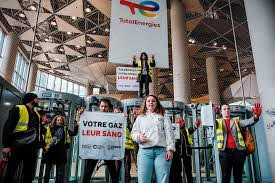
Then, the symposium turns to the role of litigation and courts in the implementation of the French law. Marie de Pinieux’s blog will provide a general overview of the law’s enforcement by French courts. Begüm Kilimcioğlu focuses on the main procedural issues faced by plaintiffs when trying to bring companies to court under the law, while Nicky Touw asks how to prove a breach of the duty of vigilance and explores the role of information sharing (or lack thereof) in this regard. Lucie Chatelain, Maddalena Neglia and Chloe Pasmantier draw from their experience in litigating the Suez case to discuss the challenges faced by CSOs in unravelling complex corporate networks and identifying the right duty-bearers under the French law. Marcellin Jehl’s post analyses the judicial actions taken by CSOs against TotalEnergies regarding their operations in Uganda. Finally, basing himself on his involvement in the case of Notre Affaire à Tous, also against TotalEnergies, Paul Mougeolle argues that due diligence norms have an important role to play in climate litigation.
The following part of the symposium interrogates how the French law affects people abroad and integrate their views in the due diligence process. Almut Schilling-Vacaflor and Maria-Therese Gustafsson study how CSOs from France and Brazil that have been involved in several duty of vigilance court cases perceived and experienced the lawsuits and the political contestations surrounding them. Rafaella Monesi delves into the repercussions in Brazil of the same lawsuits through an analysis of the media reactions and public statements of the parties involved. Céline da Graça Pires focuses on the place and practice of stakeholder consultations as part of the duty of vigilance. Finally, the contribution of Debadatta Bose points out the marginalization of workers and communities from the Global South in the law’s set up, while Fatimazahra Dehbi applies a Third World Approaches to International Law (TWAIL) lens to criticise what she considers as the law’s key blind spots.
Eventually, the two final blogs put the law in the context of the recent adoption of the Corporate Sustainability Due Diligence Directive (CSDDD). Seniha Irem Akin compares key provisions of the French law and the CSDDD and draws some lessons for the latter, while Tim Bartley and Maria-Therese Gustafsson investigate how French businesses have positioned themselves in the legislative process that led to the adoption of the CSDDD.


Leave a Reply