






The Tilenga and EACOP projects, developed by TotalEnergies in Uganda and Tanzania, have, in the words of the multinational’s CEO, “become the symbol of the anti-oil fight.”
These projects have sadly gained notoriety due to the scale of human rights violations and the potential for irreversible environmental and climate damage they present.
Although these projects are still under development, the international response has become a textbook example of collective action. Mobilisation, advocacy, and legal action are just some of the strategies employed by global civil society to oppose these initiatives.
These projects have also been the focus of the first-ever legal action in France under the 2017 Duty of Vigilance Law. The post delves into the intricate process of building a legal case, in France, in response to immediate damage occurring in distant jurisdictions. After summarising the main violations at stake and the legal basis, it underscores the critical need for the engagement and coordination of affected communities and other civil society organisations. The post also addresses the challenges of enforcing the then-novel Duty of Vigilance Law – a task made all the more delicate by the high expectations generated by the public campaign surrounding the case.
A devastating megaproject
TotalEnergies is one of the world’s largest oil and gas majors. The French-based multinational is currently the primary operator of the Tilenga project, which aims to extract around 230,000 barrels of oil per day from the Ugandan side of Lake Albert. TotalEnergies plans to drill over 400 wells across 31 oil platforms, with ten of these platforms (around 130 wells) located within the country’s oldest and largest protected natural area: Murchison Falls National Park, an exceptional reserve through which the Victoria Nile flows.
The project also involves substantial infrastructure development along the park’s periphery, including roads, a processing plant, pipelines linking the various wells, and a system for drawing water from Lake Albert. Additionally, the Tilenga project is linked to the construction of the East African Crude Oil Pipeline (EACOP), in which TotalEnergies is also a majority shareholder. This massive 1,443km pipeline is designed to transport oil from Uganda to the Tanzanian coast for export.
- Human rights violations. Over 100,000 people are affected by the projects. The forced land acquisition process has led to, and continues to cause, severe human rights abuses. These violations are particularly linked to the lack of fair compensation before the evictions and the forced deprivation of land, which have severely impacted local families who rely on their land for their livelihoods. This situation infringes on a wide range of rights, including the right to property, an adequate standard of living, food, education, health, decent housing, life and security, and free, prior, and informed consent. Moreover, many of those affected continue to face threats, intimidation, and imprisonment. An interactive map highlights the various violations.
- Environmental damage. The Tilenga project is being developed in the Albertine Rift, one of Africa’s most biodiverse regions. American environmentalist Bill McKibben commented in The New Yorker that “The proposed route looks almost as if it were drawn to endanger as many animals as possible.” Indeed, the projects threaten vital wildlife corridors. Furthermore, the exploitation of Lake Albert’s water and the risk of leakages pose serious threats to the natural environment and to the local populations who rely on fishing and farming for their livelihoods.
- Significant climate impact. This megaproject is projected to emit over 379 million tonnes of CO2 into the atmosphere over its nearly 30-year lifespan. TotalEnergies’ project represents a “carbon bomb” that is fundamentally incompatible with the goal of limiting global warming to 1.5°C, as set out in the Paris Agreement.
Taking legal action
In 2019, several French and Ugandan NGOs formally notified TotalEnergies under the new Duty of Vigilance Law. This law imposes a duty of care on large companies established in France to identify risks and prevent serious human rights and environmental abuses. Specifically, companies are required to adopt and effectively implement appropriate measures to prevent or mitigate these risks.
This obligation falls on the parent company and extends extraterritorially to cover risks across the entire global value chain, including subsidiaries, suppliers, and subcontractors with whom an ‘established business relationship’ exists.
Following TotalEnergies’ terse response to the risks associated with these projects, the NGOs took the company to court to effectively prevent these serious abuses. What followed were nearly four years of protracted legal proceedings (despite opting for the fast-track route), during which TotalEnergies succeeded in having the case ruled inadmissible in a highly questionable judgment.
The legal battle against TotalEnergies in France resumed in June 2023 with the initiation of a civil liability case seeking compensation for human rights violations that have occurred since 2017. This action is being brought by 27 affected individuals and five Ugandan and French NGOs.
The agency of affected communities
Contrary to TotalEnergies’ claims, these projects will hardly benefit the local population. Only a small fraction of the local workforce is expected to be employed on the project, and the oil is primarily intended for export. Most of the value is captured by a foreign multinational, which has also pressured the Ugandan government to minimise tax payments related to the projects. TotalEnergies’ allegation that foreign NGOs opposing the project are engaging in neo-colonialism is therefore particularly inappropriate. Continuing to work with local organisations and closely collaborating with affected people is imperative to defuse such a narrative.
The close relationship between French, Ugandan, and Tanzanian NGOs is crucial for the success of the legal action. Local partners are uniquely positioned to gather the essential evidence needed for the proceedings in France. Their on-the-ground support is vital to the case, as they can build trust with affected individuals, record testimonies about abuses, collect first-hand evidence regarding the compensation process, document communications between affected people and TotalEnergies’ contractors, and witness environmental degradation firsthand.
That said, opponents of the project are risking their lives to make their voices heard and gather these essential documents. Consequently, our legal action also seeks compensation for the intimidation and threats suffered by certain individuals in connection with the projects. These attacks persist unabated: a Ugandan environmental activist was recently kidnapped and threatened for several days, and protests in both Uganda and Tanzania continue to be harshly repressed.
Coordinating multi-faceted resistance
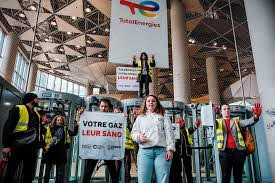
Global civil society employs a range of complementary tools: mobilisation, advocacy, and legal action. The creation of the international StopEACOP coalition has drawn significant attention to the project, gathering nearly a million signatures calling for its abandonment. Crucially, the coalition has also prompted several major banks to withdraw from the project. In addition to Friends of the Earth France and Survie, several other organisations have documented the abuses committed on site. These include FIDH, Human Rights Watch, Global Witness, and the interfaith coalition Greenfaith. These investigations are used in litigation to demonstrate the risks that TotalEnergies has overlooked and the resulting damage. These efforts have also led to the official condemnation of the projects by the European Parliament, several United Nations special rapporteurs, and even the Vatican.
These actions, particularly the legal challenges, have compelled TotalEnergies to communicate and respond—albeit still inadequately—regarding the displacements, the compensation process, and the environmental impacts.
Overcoming enforcement difficulties
In France, the Vigilance Law does not provide for criminal or administrative oversight. Instead, it is up to claimants to initiate proceedings before civil courts. While this approach offers claimants some flexibility in managing the proceedings, it also presents numerous procedural challenges and creates an imbalance between the parties. Without a reversal of the burden of proof, it remains extremely difficult for affected individuals and civil society to gather the necessary evidence, as much of the crucial information is held by the company itself. These challenges are further compounded by the dangers and difficulties of collecting evidence and testimonies in authoritarian countries like Uganda. Adjusting the burden of proof would therefore be a valuable step, for instance, as part of the transposition of the EU Corporate Sustainability Due Diligence Directive, which is expected to lead to amendment of the Vigilance Law.
Striving for effective judicial outcomes
Legal action against large-scale projects and a multinational company raises important questions about the powers of civil courts, particularly in the context of emergency procedures. For example, in their preventive action against the Tilenga and EACOP projects in 2019, the claimants sought an order to suspend the projects until TotalEnergies implemented appropriate measures to prevent or mitigate the serious abuses involved. However, as the lawsuit was deemed inadmissible, these demands were not examined.
Nonetheless, other ‘duty of vigilance’ cases are currently being considered on their merits. The Paris Court of Appeal, which now has a specialised chamber, will soon have the opportunity to determine the extent to which civil courts can act in such cases. Although courts may be hesitant, there is little doubt that they have the authority to order the suspension or substantial modification of large projects abroad. The Vigilance Law indeed empowers the court to require a company to fulfil its obligations, which explicitly include adopting and effectively implementing appropriate measures to address identified risks. The open question remains how specific the court can be in its injunctions.
For now, the Tilenga and EACOP projects continue their harmful course, drawing global condemnation. While the legal proceedings follow their own – very lengthy – path, this case has helped shed light on these detrimental projects at each stage of the process. It has also contributed to building a strong coalition worldwide that goes far beyond the legal implications of the case. However, campaigning for affected communities under novel legislation or innovative legal approaches may raise hopes that civil society organisations, particularly in the Global North, must manage carefully.

Leave a Reply