


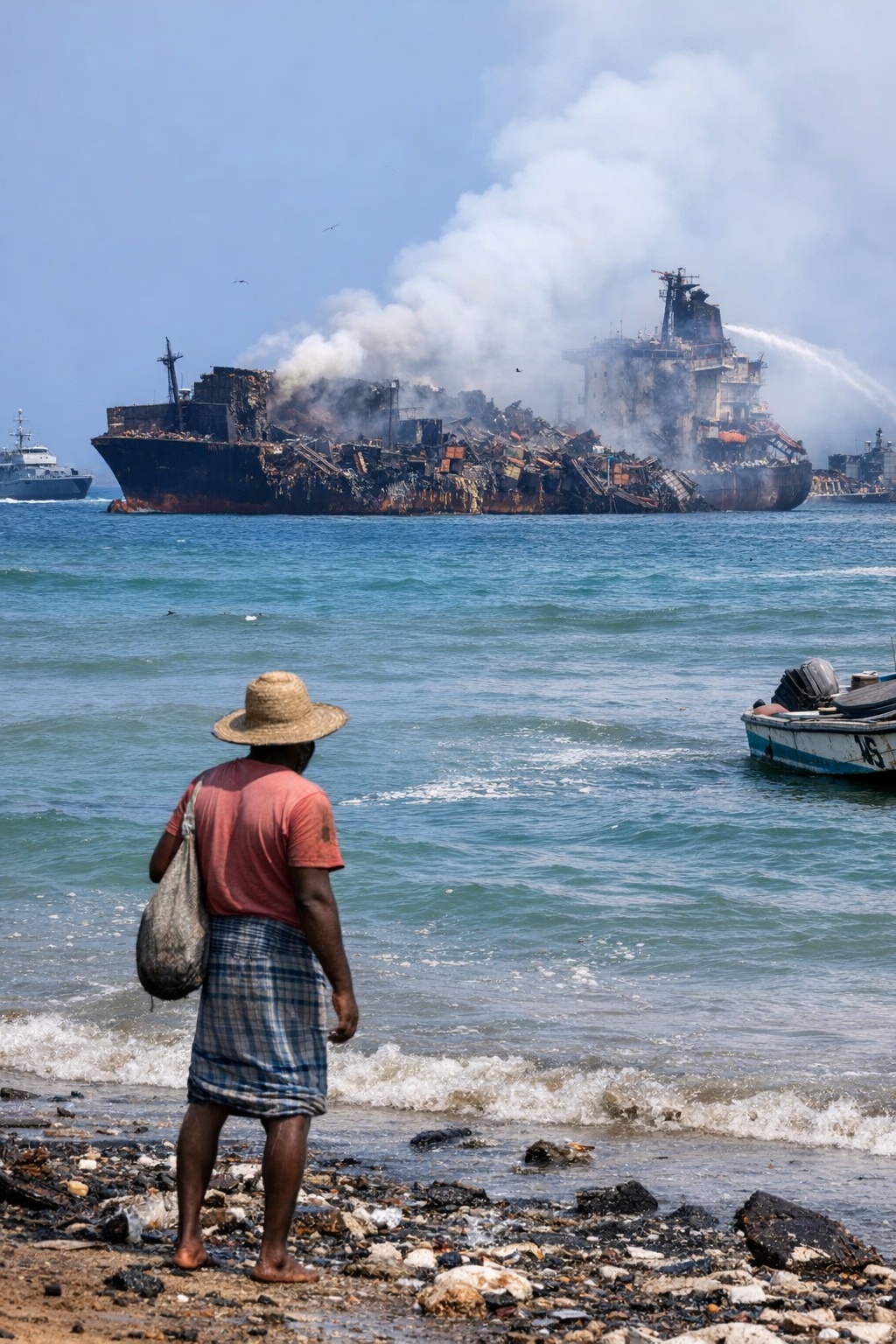
When the cargo vessel X-Press Pearl caught fire off the coast of Sri Lanka in May 2021, attention initially focused on emergency response. The ship burned for days before eventually sinking, releasing hazardous chemicals and billions of plastic pellets into the Indian Ocean. Fishing was suspended along large stretches of the coastline. For many coastal communities, daily access to the sea is not supplementary income but a basis of subsistence. That access disappeared almost overnight.
Foreseeable Harm in Global Shipping
The scale of the environmental damage and the disruption to livelihoods are now well documented. What is less examined is how familiar and legally foreseeable the underlying risks were. Transporting hazardous cargo through ecologically sensitive and livelihood-dependent coastal regions is not unusual within global shipping. The possibility of marine pollution, shoreline contamination, and loss of income for fishing communities is an inherent risk of transporting hazardous cargo through ecologically sensitive coastal regions. These risks are anticipated in regulatory frameworks, reflected in insurance practices, and incorporated into corporate risk management. In this sense, what occurred with X-Press Pearl was not outside the horizon of expectation.
Yet foreseeability did not carry particular weight while the harm remained prospective. The risks associated with the cargo and its route were absorbed into ordinary commercial decision-making; they were handled through compliance checks, insurance coverage, contractual allocation of responsibility, and emergency preparedness planning rather than treated as reasons to interrupt or redesign ongoing operations. They became contingencies to be managed, not triggers for substantive restraint.
Why Foreseeability Matters Under the UNGPs
This familiarity matters from the perspective of the UN Guiding Principles on Business and Human Rights (UNGPs). The UNGPs are concerned not with hindsight, but with whether risks to people can reasonably be identified in advance and whether businesses take appropriate steps to prevent or mitigate them through human rights due diligence. Under the UNGPs, responsibility is organised around distinct institutional roles. States have a duty to protect against business‑related human rights abuse through regulation, oversight, and effective access to remedy, while companies have a responsibility to respect human rights by identifying, preventing, mitigating, and accounting for adverse impacts linked to their operations and business relationships. For businesses, this responsibility is given effect primarily through human rights due diligence, conceived as an ongoing, risk‑based process rather than a set of fixed outcome guarantees. The UNGPs articulate this standard in terms of continuous assessment, mitigation, and use of leverage within existing commercial arrangements, rather than as a detailed catalogue of ex ante prohibitions on specific activities. This allocation of roles helps explain how foreseeable harm can be recognised and managed through prioritisation and risk mitigation, without necessarily and automatically requiring companies to suspend or redesign business operations in every case where risks are identified.
In the case of X-Press Pearl, the potential for serious environmental harm and livelihood disruption along Sri Lanka’s coast was identifiable well before the ship sank. Given the scale of the possible impact and the limited capacity of affected communities to absorb loss, these risks were also severe in the sense understood by the UNGPs. This is not to suggest that the specific ignition event was predictable or intentional. The point, rather, is that the potential for catastrophic pollution and livelihood loss is a foreseeable feature of hazardous cargo transport at sea, even when the proximate cause is accidental.
In such settings, substantive operational intervention, such as rerouting away from ecologically sensitive coastlines, delaying transit until safety concerns are resolved, or declining particularly high-risk cargo where mitigation is inadequate, might have reduced the severity of harm. This does not suggest that the risks were ignored. Rather, it points to how responsibility is structured within business and human rights frameworks.
Procedural Responsibility and Its Limits
Under the UNGPs, identifying risk primarily gives rise to duties of process. Businesses are expected to assess actual and potential impacts, document findings, and take reasonable steps to mitigate harm. What the framework generally avoids is compelling substantive prioritisation before damage has occurred. Foreseeable harms, especially when they are collective and locally embedded, may therefore be acknowledged without becoming decisive. This is not a matter of poor implementation. It reflects a design choice that privileges procedural responsibility over decisions that would require redistributing risk or foregoing otherwise lawful economic activity.
This design has predictable effects. The UNGPs emphasise that due diligence should focus on risks to people rather than risks to the business, and that severe risks should be prioritised even where companies lack full control and must rely on leverage through business relationships. In practice, however, not all risks to people interrupt business activity in the same way. Harms that carry immediate implications for compliance, insurability, or reputation are more likely to affect decision-making than harms whose consequences are borne primarily by distant or marginalised communities.
When Risk Is Recognised but Remains Tolerable
The X-Press Pearl disaster illustrates this distinction clearly. The harms that ultimately affected Sri Lanka’s coastal communities were foreseeable in a general sense: not because the precise sequence of events was predictable, but because hazardous cargo incidents at sea carry an identifiable risk of catastrophic pollution and livelihood disruption even when the trigger is accidental. Responsibility for preventing such harm was spread across operators, insurers, regulators, and supply-chain relationships. No single actor was positioned to treat the risk as decisive. In such a setting, foreseeability did not sharpen responsibility but became background knowledge within a system of distributed roles rather than a trigger for decisive preventive action.
This raises a more basic question about whose risks count as business-relevant and whose rights are disadvantaged within human rights due diligence frameworks. The rights most directly affected by X-Press Pearl included access to subsistence livelihoods, environmental integrity, and long-term ecological dependence. These are collective interests closely tied to place and environmental conditions. They do not translate easily into individualised claims or standardised corporate metrics, nor do they attach neatly to a single business relationship or decision point.
Business and human rights frameworks have made real progress in recognising the human consequences of corporate activity. At the same time, they remain more comfortable addressing harms that are attributable, individualised, and remediable after the fact. Where harm is collective, cumulative, and environmentally embedded, recognition often follows only once damage is visible and irreversible. In such cases, responsibility remains reactive even when risk was apparent in advance.
What would Human Rights Due Diligence Have Required Here?
It is true that human rights due diligence under the UNGPs is intended to be preventive and ongoing. In principle, identifying severe risks should prompt companies to take active steps to prevent harm, including through stronger safeguards, leverage in business relationships, and, where necessary, reconsideration of operational decisions. The difficulty, however, is that HRDD is often structured as a process of risk assessment and mitigation within existing commercial parameters, rather than as a mechanism that requires certain high-risk activities to be halted or fundamentally redesigned. In cases like X-Press Pearl, where potential harm is catastrophic, collective, and distributed across multiple actors, even robust due diligence may register the risk without making it decisive. The question is therefore not whether HRDD aspires to prevention, but whether its procedural form is sufficient to interrupt the ordinary toleration of foreseeable harm. This is, of course, precisely the ambition of HRDD under the UNGPs: the question is whether that ambition can be realised where catastrophic risks are structurally normalised within existing commercial and regulatory arrangements.
After-the-Fact Accountability
The legal response to X-Press Pearl followed this pattern. Accountability emerged primarily after the disaster through domestic proceedings in Sri Lanka. Emerging mandatory due diligence regimes, such as the EU Corporate Sustainability Due Diligence Directive and Germany’s Supply Chain Due Diligence Act, are intended to shift attention further upstream by requiring companies to identify and address severe risks before harm occurs. In principle, such frameworks could strengthen incentives for preventive action and provide additional avenues for accountability beyond ordinary negligence-based claims. At the same time, they continue to operationalise responsibility largely through risk-management duties and leverage within complex transnational sectors like shipping, where attribution and control remain diffuse. A binding due diligence regime applicable to the relevant corporate actors might have strengthened ex ante obligations and created clearer points of regulatory scrutiny. It could also have increased pressure to treat certain severe risks as requiring more than documentation and mitigation. However, in transnational sectors characterised by layered ownership, outsourced operations, and fragmented supply chains, even mandatory frameworks may struggle to translate foreseeability into decisive preventive action. The limits exposed by X-Press Pearl therefore concern not only the absence of legal duties, but the difficulty of making structural risk intolerable within ordinary business practice. The Sri-Lankan Supreme Court’s application of strict liability and the polluter-pays principle marked an important acknowledgement of both environmental harm and livelihood loss. It provided a measure of remedy once damage had occurred. What it did not address was the earlier toleration of risk that made the disaster possible.
What X-Press Pearl shows is how easily foreseeable harm can be absorbed into ordinary business practice without ever becoming decisive. The risks were known, the consequences broadly anticipated, and yet nothing in the existing framework required those risks to become operationally decisive. That accommodation of harm, rather than its absence, is what the case leaves behind.

Leave a Reply